
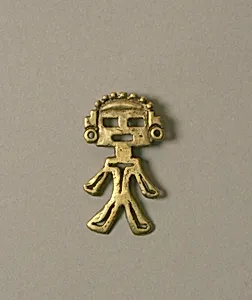
Figure Pendant
Unknown Artist
1st–7th century
Medium
Gold (cast)
Dimensions
Height 1-1/16 in. (2.7 cm)
Classification
Metal-Ornaments
Culture
Calima (Yotoco)
Department
Arts of Africa, Oceania, and the Americas
Museum
Metropolitan Museum of Art, New York, NY
Credit
Gift and Bequest of Alice K. Bache, 1974, 1977
Accession Number
1974.271.37
Rights
Public Domain
Tags
Art Historical Context
This exquisite *Figure Pendant*, crafted by an unknown artist of the Calima (Yotoco) culture in ancient Colombia between the 1st and 7th centuries, the region's mastery of goldworking. Standing just 1-1/16 inches (2.7 cm) tall, this cast gold ornament depicts a stylized human figure, likely worn as a necklace or amulet. Its petite scale belies its cultural weight, as such jewelry was prized by elites in the Cauca River Valley, where the Calima thrived as skilled metallurgists. The Calima (Yotoco) people, part of Colombia's pre-Columbian gold tradition, used lost-wax casting to create intricate pieces like this, hammering and soldering gold into fluid, dynamic forms. Gold held profound symbolic power, representing the sun, divinity, and social status—pendants like this may have invoked protection or ancestral spirits. Human figures often embodied deities or shamans, blending realism with abstraction in a style unique to Andean cultures. Housed in the Metropolitan Museum of Art's Arts of Africa, Oceania, and the Americas department (gift and bequest of Alice K. Bache, 1974, 1977), this pendant offers a window into a sophisticated society whose artistry influenced later Muisca goldwork. A testament to innovation without iron tools, it captivates with its timeless elegance.