
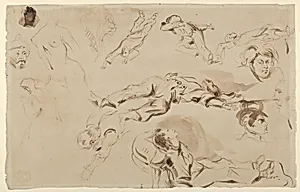
Figure Studies related to "Liberty Leading the People"
1830
Medium
Pen and brown ink, brush and brown wash
Dimensions
Overall: 8 7/16 x 13 7/16 in. (21.5 x 34.2 cm)
Classification
Drawings
Department
Drawings and Prints
Museum
Metropolitan Museum of Art, New York, NY
Credit
Gift from the Karen B. Cohen Collection of Eugène Delacroix, in honor of Keith Christiansen, 2013
Accession Number
2013.1135.12
Rights
Public Domain
Tags
Art Historical Context
Eugène Delacroix, master of French Romanticism, created theseFigure Studies related to "Liberty Leading the"* in 1830 amid the fervor of the July Revolution. uprising toppled the Bourbon monarchy of Charles X, igniting Paris with calls for liberty and republican ideals. Delacroix channeled this revolutionary spirit into his monumental painting *Liberty Leading the People* (1830), now housed in the Louvre, where a bare-breasted Marianne rallies diverse fighters—workers, students, and bourgeoisie—over a barricade strewn with the fallen. These preparatory drawings capture the raw energy of that iconic scene, exploring dynamic poses of soldiers, civilians, and the allegorical figure of Liberty herself. Executed in pen and brown ink with brush and brown wash on paper (8 7/16 x 13 7/16 in.), the studies showcase Delacroix's virtuoso technique. The fluid lines and subtle washes build volume and movement, prioritizing emotional intensity over classical precision—a hallmark of Romanticism. Loose, expressive strokes evoke the chaos of battle, allowing Delacroix to refine compositions through rapid iteration, a method that brought unprecedented drama to history painting. A gift from the Karen B. Cohen Collection to the Metropolitan Museum of Art in 2013, these sheets offer an intimate glimpse into Delacroix's creative process, bridging the sketchpad to one of modern art's most enduring symbols of freedom and defiance.
About the Artist
Eugène Delacroix · 1798–1863
Eugène Delacroix (1798–1863) stands as the defining figure of French Romanticism and a pivotal bridge to modernism. Born in Charenton-Saint-Maurice near Paris, he came from distinguished lineage—his mother descended from the prestigious Oeben-Riesener furniture dynasty, while persistent speculation suggested the statesman Talleyrand may have been his biological father, a theory supported by physic...