
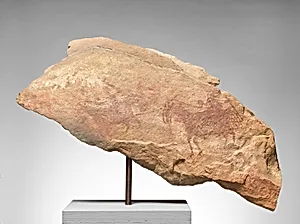
Figures on Horseback (Section of a Rock Painting)
Unknown Artist
ca. 1000 BCE–300 CE
Medium
Stone with pigments
Dimensions
Gr. H. 10 7/16 in. (26.5 cm); Gr. W. 25 11/16 in. (65.2 cm); D. 8 in. (20.3 cm); Wt. 47 lbs. (21.3 kg)
Classification
Hardstone
Culture & Period
India · late Chalcolithic–early Historic period
Department
Asian Art
Museum
Metropolitan Museum of Art, New York, NY
Credit
Anonymous Gift, in memory of Anthony Gardner, 1994
Accession Number
1994.95.1
Rights
Public Domain
Art Historical Context
In the late Chalcolithic and early Historic periods across parts of India, painters worked directly on rock faces with mineral pigments to record groups of riders and other scenes of movement. These images were made where suitable stone surfaces existed, often in open or sheltered locations, and they reflect a time when horses had become part of local lifeways. The surviving section shows how the painter adapted the composition to the uneven stone rather than smoothing it first. Figures and animals follow the rock’s natural ridges and dips, so that the line of riders appears to rise and fall with the surface itself. The thin, translucent washes of pigment allow the stone’s color and texture to remain visible, softening the outlines and letting the rock continue to participate in the image. This fragment, dated ca. 1000 BCE–300 CE and now in the Metropolitan Museum of Art, was originally part of a larger painted expanse. Look closely at the space between the two central riders, where a faint vertical stroke still links the upper contour of one figure to the lower edge of the next; that single mark shows how the painter used minimal lines to suggest both separation and forward motion across the uneven rock.