
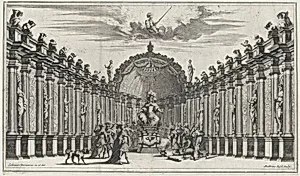
Figures worshipping the statue of an armed figure; set design from 'Il Pomo D'Oro'
Medium
Etching
Dimensions
Sheet (Trimmed): 10 3/16 × 17 3/8 in. (25.9 × 44.1 cm)
Classification
Prints|Prints-Fete|Ornament & Architecture
Department
Drawings and Prints
Museum
Metropolitan Museum of Art, New York, NY
Credit
Harris Brisbane Dick Fund, 1953
Accession Number
53.600.3554
Rights
Public Domain
Tags
Art Historical Context
Step into the lavish world of 17th-century Baroque opera with this stunning etching, *Figures worshipping the statue of armed figure; set design from 'Ilomo D'Oro'*, created in 1668 stage designer Ludovico Ottiano Burnacini andaver Mathäus Küsel This print captures a dramatic scene from Antonio Cesti's triumphant opera *Il Pomo D'Oro* (The Golden Apple), that year in Vienna to celebrate Emperor Leopold I's wedding.oring figures kneel before a towering statue of an armed deity amid grand columns, evoking ritual worship in a fantastical architectural expanse—complete with attentive dogs adding a touch of lively realism. Such sets were engineering marvels, transforming theaters into immersive spectacles of gods, heroes, and machinery. Burnacini, a master of Habsburg court theater, designed these opulent backdrops to dazzle audiences with perspective illusions and ornate ornamentation, hallmarks of Baroque extravagance. Küsel's precise etching technique preserved these ephemeral designs on paper, making imperial splendor accessible beyond the stage. Measuring about 10 by 17 inches, this trimmed sheet exemplifies the print's role in disseminating artistic innovation, bridging theater and fine art. Housed in The Metropolitan Museum of Art's Drawings and Prints department (Harris Brisbane Dick Fund, 1953), it highlights opera's cultural pinnacle in Vienna, where music, myth, and machinery fused to glorify absolutist rule. A window into forgotten performances, it reminds us how prints immortalized the era's theatrical magic.
About the Artist
Ludovico Ottaviano Burnacini|Mathäus Küsel · 1636–1707
Lodovico Ottavio Burnacini (1636–1707), born into an artistic family in northern Italy—likely Venice—was the son of the renowned theater architect Giovanni Burnacini from Cesena and his wife Grazia. From a young age, he studied under his father, mastering theater architecture, intricate stage machinery, and set design amid Venice's vibrant carnival culture and Commedia dell'arte performances. The ...