
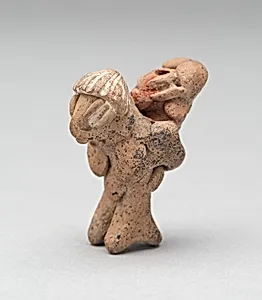
Figurine Depicting a Female Carrying a Child
500–300 BCE
Medium
Ceramic and pigment
Dimensions
H.: 3.5 cm (1 3/8 in.)
Classification
earthenware
Department
Arts of the Americas
Museum
Art Institute of Chicago
Accession Number
24640
Rights
Public Domain
Art Historical Context
This delicate ceramic figurine, created by the Chupícuaro culture in what is now central Mexico between 500 and 300 BCE, captures a tender moment of a female figure carrying a child. Standing just 3.5 centimeters tall, the small scale suggests it may have served as a personal or votive object, perhaps used in household rituals or as a burial offering. The use of earthenware with applied pigment highlights the culture’s mastery of modeling techniques, where artisans shaped clay by hand and added color to emphasize details like clothing or facial features. Chupícuaro ceramics are renowned for their lively representations of daily life and human relationships, offering rare glimpses into Preclassic Mesoamerican society. This mother-and-child motif likely symbolized fertility, nurturing, and continuity—core values in communities that relied on family bonds for survival and social cohesion. Such figurines were often placed in tombs, reflecting beliefs about the afterlife and the enduring importance of maternal roles. The warm, reddish tones typical of Chupícuaro pigment further enhance the intimate quality of the piece. Today, it provides visitors with a direct connection to one of the earliest artistic traditions in the Americas, reminding us of the universal themes that transcend time and place.