
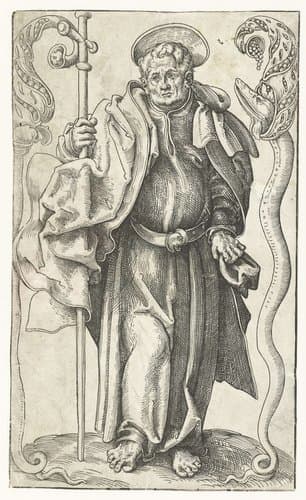
Filippus met kruis en slang
1510 - 1515
Medium
paper
Dimensions
188; 315
Rights
Public Domain
About this artwork
De heilige Filippus staat met een kruisstaf tussen ornamenten die gedeeltelijk verwijzen naar zijn marteldood. Rechts is de slang afgebeeld die door Filippus met zijn kruis uit een tempel werd gedreven. Het ornament links heeft wel het lijf van een slang maar de kop is niet zichtbaar. De slangen worden bekroond door een hoorn des overvloeds
Art Historical Context
**Filippus met kruis en slang** (Philip with Cross and Snake), created by Lucas Cranach the Elder around 1510-1515, captures a dramatic moment from the life of Saint Philip the Apostle. This intimate drawing on paper (315 × 188 mm) showcases the saint standing firmly with his crosier amid symbolic ornaments alluding to his martyrdom. Cranach, a leading figure of the German Renaissance and court painter to the Electors of Saxony, was renowned for his vivid religious scenes blending Northern detail with Italianate grace, often infused with Reformation-era humanism. At the right, a coiled snake evokes the legend of Philip exorcising a deadly serpent from a pagan temple in Hierapolis, driving it out with his cross—a powerful symbol of faith triumphing over evil. To the left, a mysterious ornament features a snake's body sans head, crowned alongside its counterpart by a cornucopia, blending peril with abundance to underscore divine providence. Executed on paper, a rarer medium for Cranach's era typically favoring wood panels, this work likely served as a preparatory study, highlighting his masterful line work and intricate symbolism. This piece reflects early 16th-century devotional art, inviting viewers to ponder sainthood's perils and triumphs amid the turbulent religious shifts of the Renaissance North. A gem for contemplation!