
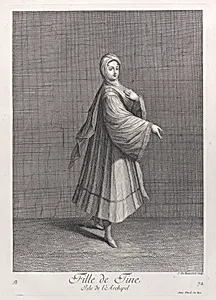
Fille de Tine, Isle de l'Archipel, plate 72 from "Recueil de cent estampes représentent differentes nations du Levant"
Medium
Etching and engraving
Dimensions
Sheet: 16 7/16 in. × 12 in. (41.8 × 30.5 cm) Plate: 14 1/8 × 9 13/16 in. (35.9 × 24.9 cm)
Classification
Prints
Department
Drawings and Prints
Museum
Metropolitan Museum of Art, New York, NY
Credit
Bequest of Mrs. Charles Wrightsman, 2019
Accession Number
2019.282.88
Rights
Public Domain
Tags
Art Historical Context
**Fille de Tine, Isle de l'Archipel** (Girl from Tinos, Island of the Archipelago), plate from the *Recueil de cent estamp représentant différentes nations du Levant (Collection of One Hundred Representing Different Nations of Levant), captures the likeness of a young woman from Greek island of Tinos in the Aegean Archipelago. Created around 1714–15, this etching and engraving depicts her traditional attire, offering a vivid snapshot of early 18th-century life in the eastern Mediterranean under Ottoman rule. Part of a renowned series of 100 prints, it documents the diverse peoples, costumes, and cultures of the Levant region, from Turkey to Greece, reflecting Europe's growing curiosity about the "Orient" during the Enlightenment. The artwork stems from designs by Jean Baptiste Vanmour, a Flemish painter who spent decades in Istanbul documenting Ottoman society for French diplomats. Engravers Jacques le Hay and Jacques de Franssières translated his lively oil sketches into precise prints using etching for fluid lines and engraving for intricate details, achieving remarkable tonal depth on a modest plate size of about 14 × 10 inches. This collaborative technique made the series accessible and popular across Europe. Housed in the Metropolitan Museum of Art's Drawings and Prints department, this piece highlights cultural exchange in a cosmopolitan era, blending Western printmaking with Eastern subjects. It's a charming window into forgotten island traditions, reminding us how art preserved vanishing worlds. (218 words)
About the Artist
Jacques le Hay|Jacques de Franssières|Jean Baptiste Vanmour (French| ) · 1671 |1650 –1737 |1750
French, Valenciennes 1671–1737 Istanbul (Constantinople)|