
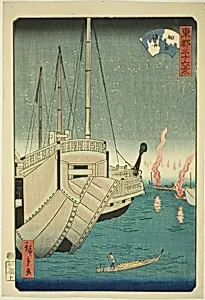
Fishing Boats at Tsukuda Island (Tsukudajima gyoshu), from the series "Thirty-six Views of the Eastern Capital (Toto sanjurokkei)"
Medium
Color woodblock print; oban
Classification
woodblock print
Department
Arts of Asia
Museum
Art Institute of Chicago
Accession Number
26669
Rights
Public Domain
Art Historical Context
Behold *Fishing Boats at Tsuk Island (Tsukud gyoshu)*, a vibrant color woodblock print by Utagawa Hirosh II (Shigenobu), created in 1862 as part of the series *Thirty-six Views the Eastern Capital (T sanjurokkei)*. This oban-sized work captures the bustling fishing life off Tsukuda Island in Edo Bay (modern Tokyo), with boats laden with nets and figures at work under a vast, dynamic sky. Hiroshige, a devoted pupil and adopted son of the legendary Utagawa Hiroshige I, carried forward the ukiyo-e tradition of depicting "floating world" scenes from everyday Japanese life. Printed during the late Edo period, amid Japan's isolation before the Meiji Restoration, the series pays homage to his master's iconic *Thirty-six Views of Mount Fuji* by shifting focus to urban vistas of the Eastern Capital. Woodblock printing, a collaborative craft involving carvers, printers, and publishers, allowed affordable mass production, making such art accessible to merchants and commoners. Hiroshige II's precise lines and subtle color gradations evoke the transient beauty of nature and labor. Housed in the Art Institute of Chicago's Arts of Asia department, this print exemplifies ukiyo-e's global legacy, influencing Impressionists like Monet and Van Gogh. It invites visitors to ponder the rhythm of coastal life in 19th-century Japan. (198 words)
About the Artist
Utagawa Hiroshige II (Shigenobu) · 1826–1869
Utagawa Hiroshige II, born Suzuki Chinpei in 1826, was one of the most accomplished ukiyo-e artists of mid-nineteenth century Japan. He entered the studio of the celebrated landscape master Utagawa Hiroshige I — known for his iconic series "The Fifty-three Stations of the Tokaido" — and proved himself the most talented of the elder artist's few students. So highly regarded was the young pupil that...