
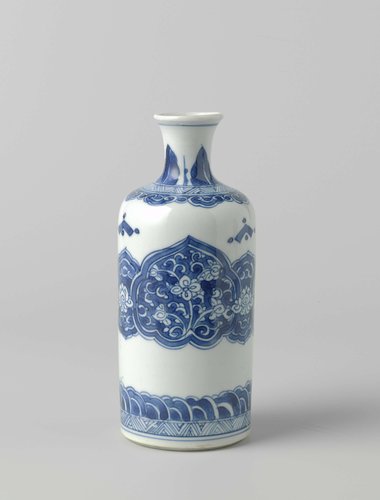
Flesvormige vaas met uitgespaarde bloemranken in ruyi-vormige cartouches
c. 1680 - c. 1720
Medium
turning
Dimensions
6.3; 16
Rights
Public Domain
Art Historical Context
This delicate bottle-shaped vase, standing just 16 cm tall and 6.3 cm in diameter, exemplifies the artistry of lathe-turning—a precision technique where wood, ivory, or similar materials are shaped on a spinning lathe for smooth, symmetrical forms. Crafted anonymously around 1680–1720, its flesh-colored surface features intricately carved flower garlands ruyi-shaped cartouches The ruyi motif, inspired by the Chinese scepter symbolizing power and good fortune, reflects the era's fascination with Asian imports via Dutch East India Company trade, blending European craftsmanship with exotic influences. The vase's provenance adds to its allure: once in the collection of Jean Theodore Royer (1737–1807), a prominent The Hague collector, it was bequeathed by his widow to King William I in 1814. It passed to the Royal Cabinet of Curiosities in 1816 before entering the museum in 1885. Such turned objects were prized in 17th- and 18th-century cabinets of curiosities for their technical virtuosity and decorative elegance, showcasing how global exchange shaped European decorative arts. A true gem of subtle sophistication!
About the Artist
anonymous
In the vast tapestry of art history, "Anonymous" stands not as a singular individual but as a collective designation for countless unidentified creators whose works have endured across millennia. These artists, spanning prehistoric cave painters to medieval illuminators and folk craftsmen, produced the foundational layers of human visual culture. Prior to the Renaissance, when individual fame emer...