
Flooding in the Forest of the Ile Séguin
1833
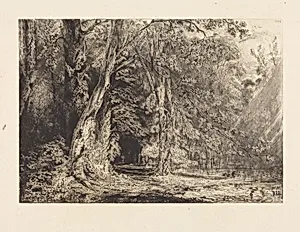
Medium
etching on chine collé
Dimensions
plate: 28.9 x 37.2 cm (11 3/8 x 14 5/8 in.) sheet: 43.9 x 60.2 cm (17 5/16 x 23 11/16 in.)
Classification
Department
CG-E
Museum
National Gallery of Art, Washington, D.C.
Credit
Ailsa Mellon Bruce Fund
Accession Number
2005.134.1
Rights
Public Domain
Art Historical Context
Paul Huet’s “Flooding in the Forest of the Ile Séguin” captures a dramatic moment of nature’s power on the small island in the Seine just west of Paris. Created in 1833 as an etching on chine collé, the print uses the delicate layering of thin Chinese paper onto a heavier sheet to achieve subtle tonal gradations and atmospheric depth. This technique allowed Huet to translate the fluid movement of water and the dense tangle of trees into a richly textured image that feels both immediate and timeless. Huet, a leading figure in the French Romantic movement, often turned to landscape subjects that emphasized the sublime forces of nature. Here, the flooding transforms an everyday riverside wood into a scene of quiet upheaval, inviting viewers to reflect on the interplay between human presence and the natural world. The work’s modest scale and meticulous printmaking reflect the growing interest in reproductive media during the 1830s, when artists sought to share evocative landscapes with wider audiences. Today the etching stands as a fine example of early nineteenth-century landscape printmaking, preserving both the visual poetry of the flooded forest and Huet’s sensitive response to the changing moods of the French countryside.
About the Artist
Paul Huet · 1803–1869
Paul Huet was born in Paris in 1803 and emerged as one of the founding figures of French Romantic landscape painting, a pioneer who helped chart the course from the classical tradition of the previous century toward the freer, more emotionally charged approach to nature that would define the Romantic era. As a young man he studied briefly with Pierre-Henri de Valenciennes and Antoine-Jean Gros, bu...