
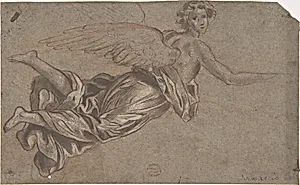
Flying Angel
17th century
Medium
Pen and brown ink, brush and brown wash, over red chalk, with white gouache highlighting. On gray-brown paper.
Dimensions
sheet: 9 x 5 1/2 in. (22.8 x 14 cm)
Classification
Drawings
Department
Drawings and Prints
Museum
Metropolitan Museum of Art, New York, NY
Credit
Gift of Cephas G. Thompson, 1887
Accession Number
87.12.159
Rights
Public Domain
Tags
Art Historical Context
Behold the *Flying Angel*, a captivating 17th-century drawing by an anonymous Italian artist, now housed in the Metropolitan Museum of Art's Department of Drawings and Prints. This intimate sheet, measuring just 9 x 5½ inches (22.8 x 14 cm), captures a dynamic celestial figure in mid-flight, rendered on gray-brown paper—a prepared surface ideal for dramatic contrasts in Baroque-era sketches. Crafted with pen and brown ink, brush and brown wash over red chalk, and accented by white gouache highlights, the work exemplifies the virtuoso techniques of Italian draughtsmen during the Counter-Reformation. These mixed media allowed artists to model form with fluid washes for shadow and glow, evoking ethereal movement and divine light. Angels like this one were staples in 17th-century religious art, often serving as studies for grand altarpieces or frescoes in churches, symbolizing spiritual intervention amid turbulent times. A generous gift from Cephas G. Thompson in 1887, this anonymous gem offers a window into the preparatory genius behind Italy's opulent Baroque masterpieces, reminding us how fleeting sketches birthed timeless visions of the heavens.