
Folio from a Kalila wa Dimna
Unknown Artist
second quarter 16th century
Medium
Ink and opaque watercolor on paper
Dimensions
Overall: H. 12 1/2 in. (31.8 cm) W. 8 7/8 in. (22.6 cm) Average text size: H. 8 5/8 in. (21.9 cm) W. 4 7/8 in. (12.4 cm)
Classification
Codices
Department
Islamic Art
Museum
Metropolitan Museum of Art, New York, NY
Credit
The Alice and Nasli Heeramaneck Collection, Gift of Alice Heeramaneck, 1981
Accession Number
1981.373.97
Rights
Public Domain
Tags
Art Historical Context
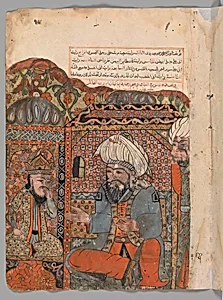
This exquisite folio from a *Kalila wa Dimna* manuscript created by an unknown artist in the quarter of the 16 century, offers a glimpse into the rich of Islamic illuminated codices. *Kalila wa Dimna an Arabic adaptation of ancient Indian fables known as the Panchatantra features anthropomorphic animals and moral tales that impart wisdom on kingship, friendship, and ethics. Popular across Persian and Islamic courts, such manuscripts were prized for their blend of storytelling and artistry, often produced in workshops in Safavid Iran or Mughal India. Rendered in ink and opaque watercolor on paper, the folio exemplifies the refined techniques of Persian miniature painting. Delicate lines define figures—likely men, as suggested by the tags—while vibrant, jewel-toned pigments create a harmonious composition within the page's borders (overall 12½ × 8⅞ in.). The text block (averaging 8⅝ × 4⅞ in.) integrates seamlessly with illustrations, a hallmark of codices that elevated reading into a visual feast. Housed in the Metropolitan Museum of Art's Islamic Art Department as part of The Alice and Nasli Heeramaneck Collection (gift of 1981), this folio highlights the cultural exchange between East and West. It underscores how these manuscripts preserved timeless narratives, influencing literature and art for centuries, and invites visitors to ponder the enduring lessons hidden in its intricate details.