
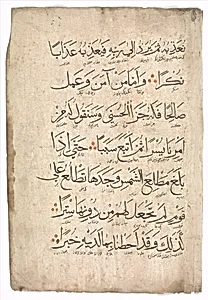
Folio from a Qur'an Manuscript
Unknown Artist
14th century
Medium
Ink on paper
Dimensions
H. 19 1/2 in. (49.5 cm) W. 14 in. (35.5 cm)
Classification
Codices
Department
Islamic Art
Museum
Metropolitan Museum of Art, New York, NY
Credit
Louis E. and Theresa S. Seley Purchase Fund for Islamic Art, 1979
Accession Number
1979.295.8
Rights
Public Domain
Tags
Art Historical Context
This exquisite folio from a 14th-century Qur'an manuscript, crafted by an unknown artist, exemplifies the pinnacle of Islamic calligraphy. Measuring an impressive 19½ by 14 inches (49.5 by 35.5 cm), it features meticulously rendered ink on paper, forming a single page from a larger codex—a bound book format that revolutionized manuscript production in the Islamic world by the 9th century. Housed in the Metropolitan Museum of Art's Islamic Art Department (acquired through the Louis E. and Theresa S. Seley Purchase Fund in 1979), it invites visitors to marvel at the sacred text's visual harmony. In the medieval Islamic tradition, Qur'an manuscripts were not mere books but profound works of devotion, where the beauty of script conveyed spiritual reverence. Produced during a flourishing era of Islamic scholarship and patronage—spanning regions like Persia, Egypt, and the Maghreb—this folio reflects the era's emphasis on precision and rhythm in writing. The large scale suggests it belonged to a monumental volume, often created for mosques or royal libraries, underscoring the cultural centrality of the Qur'an as Islam's holy scripture. Artistically, the ink's fluid lines highlight techniques like angular Kufic or flowing Naskh scripts (common in the period), prioritizing legibility and aesthetic grace over illustration to honor aniconic principles. Standing before it, one senses the scribe's piety and skill, a timeless bridge to the 14th century's vibrant intellectual world.