
Fork
Unknown Artist
1839–40
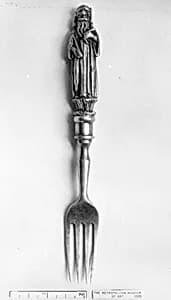
Medium
Silver gilt
Dimensions
Length: 7 5/8 in. (19.4 cm)
Classification
Metalwork-Silver
Culture
British, London
Department
European Sculpture and Decorative Arts
Museum
Metropolitan Museum of Art, New York, NY
Credit
Bequest of Alfred Duane Pell, 1924
Accession Number
25.130.11
Rights
Public Domain
Tags
Art Historical Context
This elegant silver gilt fork, crafted in London around 1839–40 during the early Victorian era, exemplifies the exquisite metalwork produced by British silversmiths. Measuring 7 5/8 inches in length, it belongs to the Metropolitan Museum of Art's European Sculpture and Decorative Arts collection, gifted through the bequest of Alfred Duane Pell in 1924. Silver gilt—silver coated with a thin layer of gold—combines the durability of silver with the opulent sheen of gold, a technique prized for luxury tableware that resisted tarnish while signaling wealth and refinement. In Victorian Britain, dining became a grand social ritual, and items like this fork were essential to elaborate place settings in affluent households. London's silversmithing tradition, regulated by hallmarking systems, ensured high standards of craftsmanship, often featuring intricate chasing or piercing (though specifics here are undocumented). Forks of this period marked a shift from earlier two-tined designs to the modern three- or four-tined form, reflecting evolving table manners influenced by European courts. Though the artist remains unknown, this piece highlights the artistry of anonymous artisans whose work adorned the tables of London's elite. Tagged with "Men," it may evoke the era's gendered dining customs, where such silverware featured in gentlemen's clubs or formal male gatherings. A subtle survivor of 19th-century opulence, it invites us to savor the intersection of function, fashion, and fine craft.