
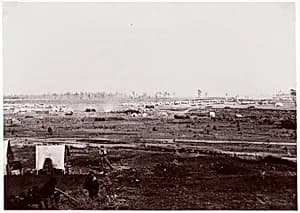
Fort Burnham, front of Petersburg
1861–65
Medium
Albumen silver print from glass negative
Classification
Photographs
Department
Photographs
Museum
Metropolitan Museum of Art, New York, NY
Credit
Harris Brisbane Dick Fund, 1933
Accession Number
33.65.155
Rights
Public Domain
Tags
Art Historical Context
Captured during the American Civil War (1861–65), *Fort Burnham, front of Petersburg* is an album silver print from a glass, attributed to pioneering photographer Mathew B. Brady his studio. This poignant landscape depicts Union fortifications at Fort Burnham, a key position during the prolonged Siege of Petersburg (1864–65), where General Ulysses S. Grant's encircled Confederate defenses in a grueling campaign that foreshadowed the war's end. Tents dot the scene, evoking the harsh realities of camp life amid Virginia's rugged terrain. Brady, often called the "father of American photography," dispatched teams to document the conflict, producing some of the earliest visual records of modern warfare. The albumen process—using egg whites to bind silver salts on paper—yielded crisp, detailed images from large glass negatives, allowing unprecedented realism. Donated to The Metropolitan Museum of Art via the Harris Brisbane Dick Fund in 1933, this print preserves a moment of strategic tension. For visitors, it offers a window into the Civil War's human scale: not just battles, but the everyday endurance of soldiers. Its stark composition highlights photography's power to shape public perception, turning distant strife into intimate history.
About the Artist
Mathew B. Brady|Unknown · 1823–1896
Mathew B. Brady (c. 1823–1896) was an American photographer who became the most famous photographer of the Civil War era and one of the founding figures of American photographic history. Born in Warren County, New York, to Irish immigrant parents, he learned the daguerreotype process from Samuel F.B. Morse and William Page and opened his first portrait studio in New York City in 1844. Brady quick...