
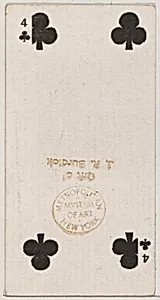
Four Clubs (black), from the Playing Cards series (N84) for Duke brand cigarettes
Medium
Commercial color lithograph
Dimensions
Sheet: 2 3/4 x 1 1/2 in. (7 x 3.8 cm)
Classification
Prints|Ephemera
Department
Drawings and Prints
Museum
Metropolitan Museum of Art, New York, NY
Credit
The Jefferson R. Burdick Collection, Gift of Jefferson R. Burdick
Accession Number
63.350.204.84.31
Rights
Public Domain
Tags
Art Historical Context
In the late 19th century, American tobacco companies like W., Sons & Co. revolutionized marketing by distributing colorful trade cards with their products. This tiny chromolithograph, *Four Clubs (black)* the Playing Cards series (84) issued in 1888, exemplifies strategy. Designed to mimic a suit of playing cards, it promoted Duke's popular cigarettes, enticing smokers and collectors alike. At just 2¾ x 1½ inches, these ephemera were perfect for albums, sparking a collecting craze that boosted brand loyalty. The artwork showcases commercial color lithography, a breakthrough technique allowing vibrant, mass-produced images on paper. Bold black clubs stand out against a simple ground, blending whimsy with precision to evoke the thrill of a card game. Duke's innovative series tapped into everyday leisure, reflecting how advertising infiltrated popular culture during America's Gilded Age. Today, preserved in the Metropolitan Museum of Art's Jefferson R. Burdick Collection—a treasure trove of American prints and ephemera—this card offers a window into graphic design's commercial roots and the social history of tobacco promotion. A delightful snapshot of Victorian-era ingenuity!
About the Artist
W. Duke, Sons & Co. · 1870–1920
**W. Duke, Sons & Co.: Pioneers of Chromolithographic Trade Card Art** W. Duke, Sons & Co., an American tobacco manufacturer, emerged from the entrepreneurial vision of Washington Duke (1820–1905) and his sons in Durham, North Carolina. After the Civil War, Washington abandoned farming in 1874 to join his eldest son, Brodie L. Duke, in the burgeoning tobacco trade, establishing a factory that for...