
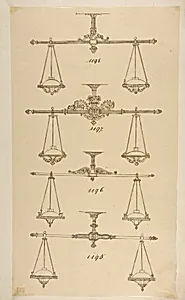
Four Designs for Hanging Light Fixtures
19th century
Medium
Pen and brown ink
Dimensions
sheet: 16 x 9 1/8 in. (40.6 x 23.1 cm)
Classification
Drawings
Department
Drawings and Prints
Museum
Metropolitan Museum of Art, New York, NY
Credit
Rogers Fund, 1966
Accession Number
66.631.127
Rights
Public Domain
Tags
Art Historical Context
This delicate sheet of pen and brown ink drawings presents four elegant designs for hanging fixtures, crafted by an anonymous French artist in the 19th century Measuring a compact 16 x 9 1/8 inches, the sketches showcase intricate, functional forms likely intended for opulent interiors, such as grand salons or theaters during France's Second Empire era. design captures the era's flair for elaborate ornamentation, with scrolling arms, tiered tiers, and decorative motifs that evoke the lavish chandeliers illuminating Paris's newly renovated boulevards under Baron Haussmann. The use of pen and brown ink—a precise, economical medium favored by architects and designers—highlights the drawing's practical origins. These fluid lines allowed for quick yet detailed renderings, essential for workshops producing custom lighting amid the gaslight boom and early electric innovations. Housed in the Metropolitan Museum of Art's Drawings and Prints department (Rogers Fund, 1966), the work exemplifies how anonymous draftsmen contributed to the decorative arts, bridging functionality and aesthetic beauty. Though unattributed, this artifact offers a glimpse into 19th-century French design culture, where lighting fixtures were status symbols blending craftsmanship with emerging technology. Visitors can appreciate how such modest sketches fueled the grandeur of Europe's gilded age.
About the Artist
Anonymous, French, 19th century · 1800–1900
**Anonymous, French, 19th Century (ca. 1800–1900)** The artist cataloged as Anonymous, French, 19th century embodies the enigmatic yet essential contributions of unidentified creators to France's vibrant 19th-century art world. Active roughly between 1800 and 1900, this figure—or potentially collective workshop—produced a diverse array of works amid the nation's transition from Neoclassicism thro...