
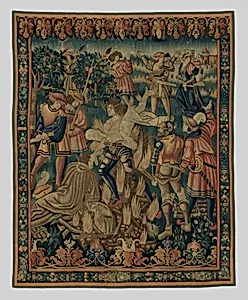
Four Episodes in the Story of Hercules
Unknown Artist
ca. 1515–35
Medium
Wool warp; wool and silk wefts
Dimensions
Overall: 159 x 132 1/2in. (403.9 x 336.6cm)
Classification
Textiles-Tapestries
Culture
South Netherlandish
Department
Medieval Art
Museum
Metropolitan Museum of Art, New York, NY
Credit
Gift of Mrs. Daniel Guggenheim, in memory of her husband, 1935
Accession Number
35.79.4
Rights
Public Domain
Tags
Art Historical Context
This magnificent South Netherlandish tapestry *Four Episodes in the Story Hercules*, dates to around 1515–35 and stands as a testament to the Renaissance-era mastery of Flemish weaving. Measuring an imposing 159 x 132½ inches, it captures dynamic scenes from the labors and adventures of the mythical hero Hercules, featuring spears, swords, and women dramatic encounters. Produced in the prosperous weaving centers of Flanders—such as Brussels or Tournai—these tapestries were prized luxury goods for Europe's nobility, adorning castle halls to insulate against cold while displaying wealth and classical learning. Woven on a wool warp with wool and silk wefts, the artwork showcases the haute lisse technique, where silk threads lent luminous highlights to figures and landscapes, creating depth and vibrancy. Though the artist remains unknown, the composition reflects the Northern Renaissance fascination with ancient Greco-Roman myths, blending them with intricate borders and vivid storytelling. Tapestries like this were collaborative efforts by designers, cartoon painters, and weavers, often taking years to complete. Housed in the Metropolitan Museum of Art's Medieval Art department as a gift from Mrs. Daniel Guggenheim in 1935, it invites visitors to marvel at the enduring allure of Hercules' strength amid Renaissance opulence—a window into 16th-century cultural prestige.