
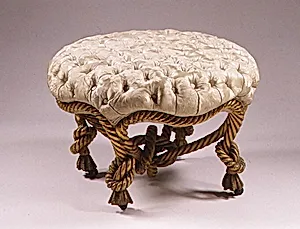
Four-legged stool
third quarter 19th century
Medium
Carved and gilded wood, silver-colored damask, brass casters
Dimensions
16 1/2 × 23 1/8 in. (41.9 × 58.7 cm)
Classification
Woodwork-Furniture
Culture
French
Department
European Sculpture and Decorative Arts
Museum
Metropolitan Museum of Art, New York, NY
Credit
Gift from the Arthur and Madeleine Lejwa Collection, 1985
Accession Number
1985.75
Rights
Public Domain
Art Historical Context
This elegant four-legged stool, crafted by A. M. E. Fournier in the third quarter the 19th century exemplifies the opulent furniture traditions of Second Empire France. Measuring just 16½ × 23⅛ inches, its compact form suggests it served as a luxurious footstool or occasional seat in a fashionable Parisian interior, where such pieces elevated everyday comfort with grandeur. Expertly carved and gilded wood forms the stool's delicate legs and frame, a technique that highlighted the woodworker's skill and the era's love for lavish surface decoration. The silver-colored damask upholstery adds a shimmering softness, while brass casters ensure smooth mobility—practical yet refined touches common in high-end French furniture. Gilding, achieved by applying thin gold leaf over bole, not only protected the wood but symbolized wealth and status amid France's industrial boom and imperial splendor. Now in the Metropolitan Museum of Art's European Sculpture and Decorative Arts collection (gift of the Arthur and Madeleine Lejwa Collection, 1985), this stool captures the fusion of craftsmanship and luxury that defined 19th-century French domestic life, inviting us to appreciate the artistry in functional beauty.