
「関戸本古今和歌集切」|Four Poems from the Sekido Version of the Collection of Poems Ancient and Modern (Sekido-bon Kokin wakashū)
mid- to late 11th century
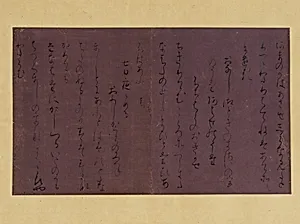
Medium
Two pages from a booklet mounted as hanging scroll; ink on dyed paper
Dimensions
Image: 8 1/4 × 13 1/2 in. (21 × 34.3 cm) Overall with mounting: 48 1/4 × 23 5/8 in. (122.6 × 60 cm) Overall with knobs: 48 1/4 × 25 1/2 in. (122.6 × 64.8 cm)
Classification
Calligraphy
Culture & Period
Japan · Heian period (794–1185)
Department
Asian Art
Museum
Metropolitan Museum of Art, New York, NY
Credit
Gift of Dian Woodner, in celebration of the Museum's 150th Anniversary, 2020
Accession Number
2020.88
Rights
Public Domain
Art Historical Context
This exquisite fragment from the Sekido-bon Kokin Wakashū showcases the refined artistry of Fujiwara no Yukinari (972–1027), one of Japan’s most celebrated calligraphers and a master of the Heian period’s distinctive Japanese script. Created in the mid- to late 11th century, these two pages—originally part of a poetry booklet—preserve four waka poems from the renowned Kokin Wakashū anthology. Now mounted as a hanging scroll, the work exemplifies the elegant fusion of literature and visual art that flourished in the Heian court. Yukinari’s fluid brushwork, rendered in ink on delicately dyed paper, reflects the period’s shift toward a uniquely Japanese calligraphic style that emphasized grace, rhythm, and personal expression over strict Chinese models. The subtle color of the paper and the lyrical arrangement of characters evoke the ephemeral beauty celebrated in waka poetry itself. As a rare surviving example of early Japanese book art, this piece offers visitors a direct connection to the sophisticated cultural world of Heian aristocrats, where calligraphy was both a practical skill and a profound artistic statement.