
Fragment
Unknown Artist
18th century
Medium
Bobbin lace
Dimensions
L. 9 1/2 x W. 2 1/4 inches (24.1 x 5.7 cm)
Classification
Textiles-Laces
Culture
German, Nuremberg
Department
European Sculpture and Decorative Arts
Museum
Metropolitan Museum of Art, New York, NY
Credit
The Nuttall Collection, Gift of Mrs. Magdalena Nuttall, 1908
Accession Number
08.180.327
Rights
Public Domain
Art Historical Context
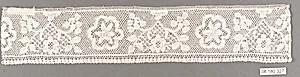
This delicate fragment of bobbin lace, crafted in 18th-century Nuremberg, Germany, exemplifies the exquisite textile artistry of the period. Measuring just 9½ by 2¼ inches, this slender piece from an unknown artist's hand was likely part of a larger decorative border or trimming for garments, linens, or furnishings. Nuremberg was a renowned center for lace production in Europe, where skilled artisans produced intricate works that adorned the elite, blending functionality with opulent display. Bobbin lace, the medium here, is a labor-intensive technique involving dozens of threaded bobbins suspended from a pillow, twisted and plaited to form patterns. Unlike needle lace, which uses a single thread and needle, bobbin lace allowed for bolder, geometric motifs and finer details through precise interweaving—skills honed over generations in workshops like those of Nuremberg. This fragment showcases the technical mastery required, with its tight stitches preserving a snapshot of everyday luxury. Housed in The Metropolitan Museum of Art's Department of European Sculpture and Decorative Arts, this piece entered the collection in 1908 as part of The Nuttall Collection, gifted by Mrs. Magdalena Nuttall. It invites us to appreciate the unsung heroes of decorative arts, whose fragile creations whisper stories of craftsmanship and cultural refinement from centuries past.