
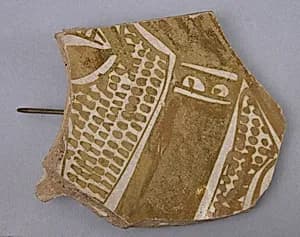
Fragment
Unknown Artist
9th century
Medium
composite body; opaque white tin glaze; luster-painted
Classification
Ceramics
Department
Islamic Art
Museum
Metropolitan Museum of Art, New York, NY
Credit
Rogers Fund, 1907
Accession Number
07.238.43
Rights
Public Domain
Art Historical Context
This exquisite ceramic fragment from the 9th century exemplifies the groundbreaking innovations of early Islamic art. Housed in the Metropolitan Museum of Art's Islamic Art Department (acquired through the Rogers Fund in 7), it survives as a testament to the Abbasid era's masterful craftsmanship, likely originating from workshops in Iraq or Mesopotamia. Though the full vessel is lost, the fragment reveals a sophisticated composite body—a fritware mixture of quartz, clay, and glass frit—designed to mimic the translucency of Chinese porcelain, which was highly prized but unavailable in the Islamic world. The artwork's medium shines through its opaque white tin glaze, a technique that provided a smooth, brilliant surface ideal for decoration. Most strikingly, it features luster-painting, where metallic oxides like copper and silver were applied over the glaze and fired in a reducing atmosphere to create a shimmering, iridescent gold effect. This revolutionary method, pioneered in the 9th century, transformed ceramics into luxurious objects rivaling gold and silverware, reserved for elite patrons. Culturally, such pieces highlight the Islamic golden age's fusion of science, trade, and artistry, influencing pottery across the Mediterranean and beyond. Visitors can marvel at how this humble fragment captures the era's quest for beauty and technical virtuosity.