
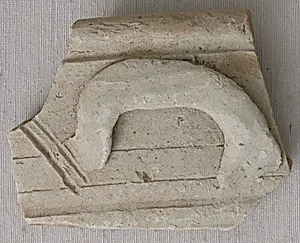
Fragment
Unknown Artist
8th–9th century
Medium
Earthenware
Dimensions
H. 2 7/16 in. (6.2 cm) W. 3 3/16 in. (8.1 cm) D. 7/8 in. (2.2 cm) Wt. 2.3 oz. (65.2 g)
Classification
Ceramics
Department
Islamic Art
Museum
Metropolitan Museum of Art, New York, NY
Credit
Rogers Fund, 1932
Accession Number
32.150.386
Rights
Public Domain
Art Historical Context
This delicate earthenware fragment, dating to the 8th–9th century, hails from the early Islamic world and invites us to ponder the artistry of everyday objects from a vibrant era. Measuring just 2 7/16 inches high and weighing a mere 2.3 ounces, it likely once formed part of a vessel—perhaps a bowl or jar—crafted for practical use in a bustling household or market. Acquired through the Rogers Fund in 1932 and now housed in the Metropolitan Museum Art's Islamic Art Department this tiny survivor speaks volumes about the resilience of ancient craftsmanship. Earthenware, fired from common clay at relatively low temperatures, was a cornerstone of early Islamic ceramics, prized for its accessibility and versatility before the widespread adoption of advanced glazing techniques. Artisans shaped and sometimes decorated these pieces with slips or incising, reflecting cultural motifs that blended local traditions with expanding trade influences across the Abbasid Caliphate. Though incomplete, this fragment exemplifies the technical skill and aesthetic sensibility of the period, where pottery bridged utility and subtle beauty. As visitors, imagine holding this lightweight relic—its smooth surfaces smoothed by time and touch. Such fragments remind us how even the smallest artifacts illuminate the ingenuity of Islamic potters, preserving echoes of a dynamic civilization for modern eyes.