
Fragment
Unknown Artist
12th–13th century
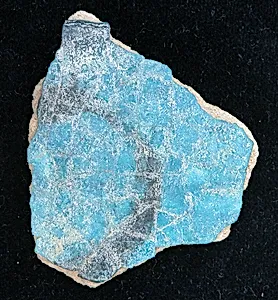
Medium
Stonepaste; underglaze painted
Dimensions
H. 2 5/16 in. (5.9 cm) W. 2 in. (5.1 cm) D. 9/16 in. (1.4 cm) Wt. 1.1 oz. (31.2 g)
Classification
Ceramics
Department
Islamic Art
Museum
Metropolitan Museum of Art, New York, NY
Credit
Gift of Mr. and Mrs. Wendell M. Hastings, 1960
Accession Number
60.23.15
Rights
Public Domain
Art Historical Context
This delicate ceramic fragment, dating to the 12th–13th century, hails from the vibrant world of Islamic art, likely produced in a Persian center like Kashan or Rayy the Seljuk period. Crafted from stonepaste—a composite of quartz, clay, and frit that mimicked the translucency of coveted Chinese porcelain—this tiny piece (just 2 5/16 inches high exemplifies an ingenious innovation. Artisans fired the stonepaste body and applied underglaze pigments beneath a transparent glaze, creating durable, vividly colored designs that resisted wear. Underglaze painting emerged as a breakthrough technique around this time, allowing intricate motifs—perhaps floral or geometric patterns, hallmarks of Islamic aesthetics—to shine through the glossy surface. Though only a fragment survives, it whispers of larger vessels or architectural tiles adorning mosques, madrasas, or palaces, where such ceramics symbolized cultural refinement and technical mastery. Today, this precious artifact graces the Metropolitan Museum of Art, thanks to the generous gift of Mr. and Mrs. Wendell M. Hastings in 1960. It invites us to marvel at the anonymous artist's skill, bridging everyday craft with enduring beauty in medieval Islamic society.