
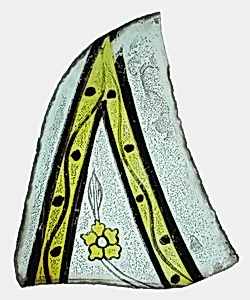
Fragment
Unknown Artist
late 14th century
Medium
Pot-metal glass and vitreous paint
Dimensions
5 13/16 × 4 3/4 × 3/16 in. (14.8 × 12 × 0.4 cm)
Classification
Glass-Stained
Culture
French or British
Department
Medieval Art
Museum
Metropolitan Museum of Art, New York, NY
Credit
Gift of George D. Pratt, 1930
Accession Number
30.73.86
Rights
Public Domain
Art Historical Context
This delicate stained glass fragment, dating to the late 14 century, hails from either France or Britain during the height of the Gothic era. Likely salvaged from a grand cathedral, it exemplifies medieval artistry designed to transform sunlight into vibrant narratives. In an age when most people couldn't read, such windows served as "poor man's Bibles," illuminating biblical scenes, saints, and moral lessons for worshippers below. Though only a small piece measuring about 6 by 4 inches remains, it whispers of the splendor once enjoyed in soaring ecclesiastical spaces. Crafted from pot-metal glass—colored throughout with metal oxides during its molten creation—and detailed with vitreous paint (a glassy enamel fired onto the surface for fine lines and shading), the fragment showcases sophisticated techniques. Pot-metal allowed for jewel-like translucency, while the paint added intricate facial features or drapery folds, enhancing realism and depth. These methods, perfected in medieval workshops, made stained glass a pinnacle of technical innovation. Today, gifted to the Metropolitan Museum of Art by George D. Pratt in 1930, this anonymous treasure invites us to ponder the fragility of history. Even in its broken state, it evokes the divine glow of Gothic light, bridging us to a world where art and faith danced in color.