
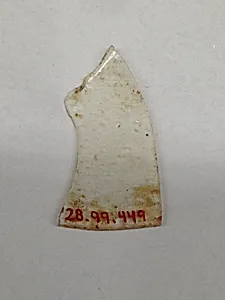
Fragment
Unknown Artist
ca. 1150–ca. 1250
Medium
Glass, ceramic
Dimensions
L. 1 3/4 in. (4.5 cm)
Classification
Glass-Vessels
Culture
European or Middle Eastern
Department
Medieval Art
Museum
Metropolitan Museum of Art, New York, NY
Credit
Gift of Clarence H. Mackay, Archer M. Huntington, Stephen H. P. Pell and Bashford Dean, 1928
Accession Number
28.99.449
Rights
Public Domain
Art Historical Context
This delicate fragment, dating to around 1150–1250, offers a tantalizing glimpse into medieval craftsmanship. Measuring just 1¾ inches long, it is a remnant of a glass vessel, possibly incorporating ceramic elements, from either Europe or the Middle East.ed in the Metropolitan Museum of Art's Medieval department, it was generously gifted in 1928 prominent collectors including Clarence H. Mackay and Bashford Dean. Such small artifacts remind us how even shards can preserve stories of daily life and luxury trade across continents. During the High Middle Ages, glassmaking flourished amid cultural exchanges spurred by the Crusades and Silk Road routes. European workshops drew inspiration from Islamic techniques, producing translucent vessels for wine, oils, or perfumes—status symbols for the elite. The uncertainty of its origin underscores this era's interconnected world, where Venetian glassblowers emulated Syrian iridescence, and ceramics added durability or decorative flair. Though worn by time, this fragment highlights the technical prowess of anonymous artisans: likely free-blown glass, cooled and perhaps trailed with threads for texture. It invites us to ponder the hands that shaped it, bridging East and West in a single, shimmering piece.