
Fragment
Unknown Artist
ca. 1150–ca. 1250
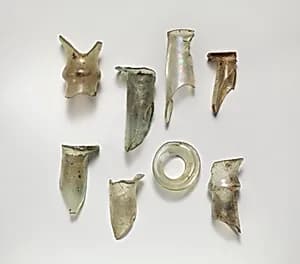
Medium
Glass, ceramic
Dimensions
greatest H. 3 1/4 in. (8.3 cm); smallest H. 3/4 in. (1.9 cm)
Classification
Glass-Vessels
Culture
European or Middle Eastern
Department
Arms and Armor
Museum
Metropolitan Museum of Art, New York, NY
Credit
Gift of Clarence H. Mackay, Archer M. Huntington, Stephen H. P. Pell and Bashford Dean, 1928
Accession Number
28.99.607
Rights
Public Domain
Art Historical Context
These delicate fragments, dating to around 1150–1250, offer a tantalizing glimpse into medieval craftsmanship from either Europe or the Middle East. Composed of glass and ceramic, the shards—ranging from a mere ¾ inch to 3¼ inches in height—likely once formed part of elegant vessels used for everyday or ceremonial purposes. Displayed in the Metropolitan Museum of Art's and Armor Department, they highlight the Met's eclectic collection, where such artifacts bridge domestic life and material culture of the era. Glassmaking during this period was a sophisticated art, often involving intricate blowing and molding techniques that produced translucent, iridescent wares prized for their luxury. Ceramic elements suggest composite vessels, possibly influenced by Islamic glass traditions that spread westward via trade routes and the Crusades, blending Eastern opulence with European utility. Their uncertain origins underscore the vibrant cultural exchanges of the 12th–13th centuries. Gifted to the Met in 1928 by prominent donors including Clarence H. Mackay and Bashford Dean, these fragments remind us how even broken remnants preserve history. Though small, they evoke the fragility of medieval life and the enduring allure of ancient materials.