
Fragment
Unknown Artist
ca. 1150–ca. 1250
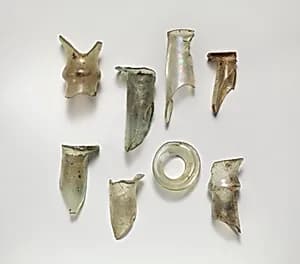
Medium
Glass, ceramic
Dimensions
greatest H. 3 1/4 in. (8.3 cm); smallest H. 3/4 in. (1.9 cm)
Classification
Glass-Vessels
Culture
European or Middle Eastern
Department
Arms and Armor
Museum
Metropolitan Museum of Art, New York, NY
Credit
Gift of Clarence H. Mackay, Archer M. Huntington, Stephen H. P. Pell and Bashford Dean, 1928
Accession Number
28.99.610
Rights
Public Domain
Art Historical Context
These delicate fragments, dating to around 1150–1250, offer a tantalizing glimpse into medieval craftsmanship from either Europe or the Middle East. Composed of glass and ceramic, the pieces—ranging from a mere ¾ inch to 3¼ inches in height—survive as remnants of small vessels, likely used for everyday purposes like drinking, storage, or perfumery. Displayed in the Metropolitan Museum of Art's Arms and Armor Department, they highlight the intersection of utilitarian art and material culture in the High Middle Ages, a time when trade routes connected distant regions, fostering innovative glassworking techniques. Glassmaking during this era was a sophisticated art, often involving free-blowing, molding, or trailing methods to create translucent, colorful forms prized for their rarity and luminosity. Whether from Islamic workshops known for iridescent finishes or European centers experimenting with imported skills, these shards reflect cross-cultural exchanges along the Silk Road and Mediterranean. Their survival underscores the fragility of such objects, preserved through generous gifts from collectors like Clarence H. Mackay and Bashford Dean in 1928. Though incomplete, these fragments invite us to imagine the vibrant hands that shaped them, evoking the daily lives of merchants, warriors, and artisans in a world of castle feasts and bustling bazaars. A humble yet profound testament to medieval ingenuity!