
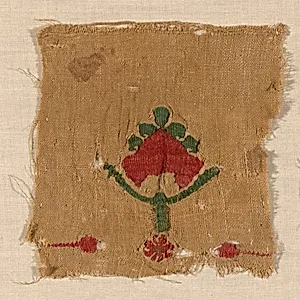
Fragment
Roman period (30 BCE– 641 CE), 5th/6th century
Medium
Linen and wool, slit tapestry weave
Dimensions
9.5 × 9.5 cm (3 3/4 × 3 3/4 in.)
Classification
textile
Department
Textiles
Museum
Art Institute of Chicago
Accession Number
1840
Rights
Public Domain
Art Historical Context
This small yet exquisite **Fragment** from the Art of Chicago's textile collection offers a glimpse into Coptic artistry during Egypt's late Roman period (5th/6th century CE). Coptic culture, blending Egyptian, Greco-Roman, and emerging Christian influences, flourished in a time of religious transition under Roman and early Byzantine rule. Textiles like this were everyday luxuries—used for clothing, furnishings, or mummy wrappings—preserving vibrant designs that survived Egypt's arid climate. Crafted in linen and wool using **slit tapestry weave**, a technique where colored weft yarns are woven side-by-side without interlocking, the fragment features characteristic bold patterns and slits along color boundaries, often left open for a textured effect or later stitched. This labor-intensive method allowed Coptic weavers to create intricate motifs with vivid dyes, showcasing their mastery of color and geometry amid a multicultural trade hub. Though tiny at 9.5 × 9.5 cm, this piece highlights the cultural significance of Coptic textiles as portable art forms, bridging pagan symbols and Christian iconography. It reminds us how ordinary objects carried profound artistic innovation, reflecting a vibrant world where faith, craft, and daily life intertwined.
About the Artist
Coptic
Coptic, the collective attribution for anonymous masters of early Christian Egypt, embodies the vibrant fusion of pharaonic, Hellenistic, and Greco-Roman traditions that defined art from the 4th century onward. Emerging in the context of Coptic Christianity's rise after the 1st century AD, these artists operated amid economic constraints that favored functional craftsmanship over elite patronage, ...