
Fragment (Band)
800 CE-1100
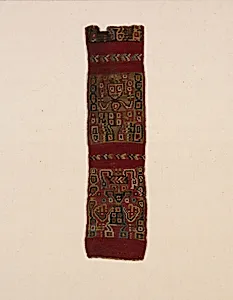
Medium
Cotton and wool (camelid), tapestry weave with supplementary weft slit closure
Dimensions
34.9 × 9.2 cm (13 3/4 × 3 5/8 in.)
Classification
textile
Department
Textiles
Museum
Art Institute of Chicago
Accession Number
18461
Rights
Public Domain
Art Historical Context
This exquisite Fragment (Band) hails from the Wari culture, a sophisticated Andean civilization that flourished in Peru from around 600 to 1100 CE. Dating to 800–1100 CE, this textile strip—measuring just 13¾ × 3⅝ inches—offers a glimpse into the Wari's mastery of weaving, which rivaled their achievements in architecture and urban planning. Wari textiles were not mere fabrics but symbols of status, used in elite garments, ritual wraps, or architectural hangings, reflecting a society that valued intricate craftsmanship as a form of cultural expression. Crafted from cotton and camelid wool (likely from llamas or alpacas), the band employs a tapestry weave technique, where colored wefts are woven back and forth to create vibrant patterns without floats. The supplementary weft slit closure—a clever method of joining motifs—ensures durability and seamless designs, often featuring geometric motifs, mythical creatures, or stylized felines that conveyed cosmological beliefs. This labor-intensive process, performed on backstrap looms by skilled artisans (primarily women), highlights the Wari's technical innovation and aesthetic precision. Housed in the Art Institute of Chicago's Textiles Department, this fragment underscores the enduring legacy of pre-Inca Andean art. Though incomplete, it invites us to imagine its role in vibrant ceremonies, bridging ancient rituals with modern admiration for textile as high art.