
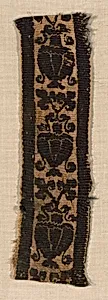
Fragment (Border)
Roman period (30 BCE– 641 CE), 4th/5th century
Medium
Linen and wool, slit tapestry weave
Dimensions
14 × 3.8 cm (5 1/2 × 1 1/2 in.)
Classification
textile
Department
Textiles
Museum
Art Institute of Chicago
Accession Number
1851
Rights
Public Domain
Art Historical Context
This delicate *Fragment (Border)* from Art Institute of Chicago offers a glimpse into the vibrant world of Coptic textiles from 4th- or 5th-century Egypt during the late Roman period (30 BCE–641 CE Coptic art, emerging from Egypt's early Christian communities, blended ancient Egyptian traditions with Roman and Byzantine, often adorning clothing, furnishings, and burial wrappings. Though small—measuring just 14 × 3.8 cm—this linen and wool border fragment likely edged a garment or textile panel, showcasing the everyday artistry of Coptic weavers. Crafted in slit tapestry weave, a technique where colorful wool wefts are inserted in discontinuous blocks without interlacing across color changes, the piece features slits along pattern edges that added texture and allowed flexibility. This method was prized for its bold motifs—typically animals, humans, or geometric designs—and durability in Egypt's hot climate, making textiles a key cultural export. As a survivor from a time of religious transformation, this fragment highlights Coptic Egypt's role as a textile powerhouse, preserving motifs that bridged pagan and Christian worlds. It's a tiny time capsule, inviting us to imagine the skilled hands that wove it amid the Nile's ancient rhythms.
About the Artist
Coptic
Coptic, the collective attribution for anonymous masters of early Christian Egypt, embodies the vibrant fusion of pharaonic, Hellenistic, and Greco-Roman traditions that defined art from the 4th century onward. Emerging in the context of Coptic Christianity's rise after the 1st century AD, these artists operated amid economic constraints that favored functional craftsmanship over elite patronage, ...