
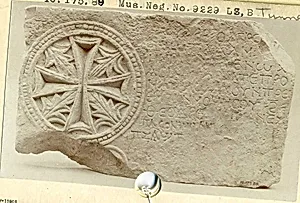
Fragment from a Funerary Stele with a Medallion of a Cross and Leaves
Unknown Artist
6th–7th century
Medium
Limestone; carved in relief
Dimensions
H. 17 5/16 in. (44 cm) W. 28 9/16 in. (72.5 cm) D. 2 3/8 in. (6 cm)
Classification
Sculpture
Department
Islamic Art
Museum
Metropolitan Museum of Art, New York, NY
Credit
Rogers Fund, 1910
Accession Number
10.175.89
Rights
Public Domain
Art Historical Context
This evocative fragment from a funeraryle, carved in low-relief limestone during the 6th–7th century, offers a glimpse into the spiritual life of early Christian communities in the Near East. Measuring about 17 inches high and 28 inches wide, it features a central medallion enclosing a cross flanked by flowing leaves, symbols of eternal life and resurrection in Christian iconography. Acquired by the Metropolitan Museum of Art through the Rogers Fund in 1910, it now resides in the Islamic Art department highlighting the cultural overlaps in regions like Syria or Egypt during the formative years of Islam. The stele's modest depth of just over 2 inches underscores the practical artistry of relief carving: shadows and contours create depth on a durable stone suited for outdoor memorials exposed to the elements. Funerary stelai like this marked graves, commemorating the deceased with motifs blending faith and nature—here, the cross asserts Christian devotion amid a period of profound religious transition following the Prophet Muhammad's era. Though the artist remains unknown, this piece exemplifies early Byzantine-influenced sculpture, bridging pagan, Christian, and emerging Islamic traditions. Its survival as a fragment speaks to the resilience of such monuments, inviting us to ponder the shared human rituals of mourning across civilizations.