
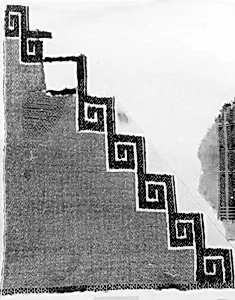
Fragment (From a mantle)
1000-1532
Dimensions
48.3 × 42.6 cm (19 × 16 3/4 in.)
Classification
textile
Department
Textiles
Museum
Art Institute of Chicago
Accession Number
85358
Rights
Public Domain
Art Historical Context
This exquisite textile fragment, originating from a Tiwanaku mantle, hails from the Andean highlands between 1000 and 1532 CE. Measuring 48.3 × 42.6 cm, it as a precious remnant of a larger garment likely worn by elites in the Tiwanaku culture—a pre-Inca civilization centered near Lake Titicaca in modern-day Bolivia. Tiwanaku society thrived on advanced agriculture, monumental stonework, and masterful crafts, with textiles serving as symbols of status, ritual power, and cosmology. As a textile classified in the Art Institute of Chicago's collection, this piece exemplifies the Tiwanaku mastery of weaving techniques, possibly employing camelid fibers like alpaca wool on backstrap looms for intricate patterns. Mantles were not mere clothing but ceremonial objects, often adorned with geometric motifs, stylized deities, or celestial symbols that encoded spiritual beliefs. Though the exact medium remains unidentified, its preservation highlights the fragility and rarity of Andean textiles, which endured burials, offerings, or daily use amid harsh highland climates. Today, this fragment invites us to marvel at Tiwanaku's enduring legacy, bridging ancient innovation with the eve of Spanish conquest in 1532, offering a tactile window into a vibrant world of color, symmetry, and sacred storytelling.