
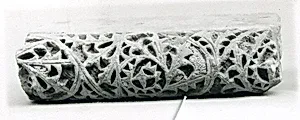
Fragment from a Molding with Scrolling Acanthus Leaves
Unknown Artist
6th–7th century
Medium
Limestone; carved in relief
Dimensions
H. 12 5/8 in. (32.1 cm) W. 7 11/16 in. (19.5 cm) D. 3 3/8 in. (8.6 cm)
Classification
Sculpture
Department
Islamic Art
Museum
Metropolitan Museum of Art, New York, NY
Credit
Rogers Fund, 1910
Accession Number
10.175.129
Rights
Public Domain
Art Historical Context
This exquisite limestone fragment, carved in low relief, showcases scrolling acanthus leaves from a larger architectural molding dating to the 6th–7th century. Measuring just over 12 inches high and 7 inches wide, it once adorned a building—likely a church, palace, or early mosque—in the early Islamic world, possibly Syria or Egypt. The intricate carving technique, where forms are subtly raised from the stone surface, highlights the mason's skill in capturing the fluid, organic curves of the leaves, a motif borrowed from classical Greco-Roman and Byzantine traditions. In the Department of Islamic Art at The Metropolitan Museum of Art, this piece exemplifies the seamless blend of pre-Islamic heritage with emerging Islamic aesthetics. Acanthus scrolls, symbolizing eternal life and paradise in ancient art, were adapted in early Islamic decoration to emphasize vegetal patterns over human figures, aligning with aniconic preferences. Acquired through the Rogers Fund in 1910, it offers a tangible link to the Umayyad era's architectural splendor. Visitors will appreciate how such fragments reveal the continuity of artistic motifs across cultures, transforming a simple molding into a window on Late Antique innovation.