
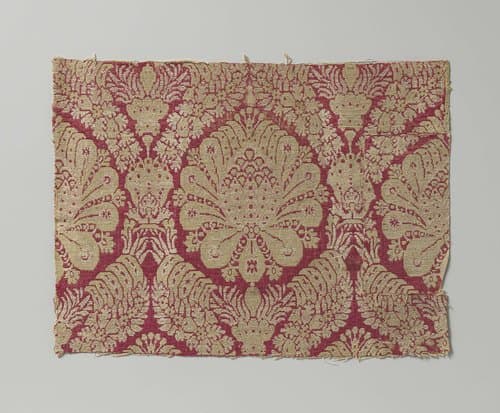
Fragment lampas van goud en wit op een rode grond
ca. 1500 - ca. 1599
Medium
lampas
Dimensions
35.9; 48.5; 12.6; 0.2
Rights
Public Domain
About this artwork
geheel: hoogte 35,9 cm x breedte 48,5 cm (exclusief 2 zelfkanten (gedeeltelijk))
Art Historical Context
This exquisite fragment of lampas textile, titled *Fragment lampas van goud wit op een rode grond hails from the Renaissance era, circa 1500–9. Measuring 35.9 cm high by 48.5 cm wide (excluding partial selvedges), it a luxurious weave of gold and white threads shimmering against a vibrant red ground. Created anonymously, likely by skilled weavers in a European center of textile production such as Italy or the Low Countries, this piece captures the opulence of 16th-century decorative arts. Lampas, a sophisticated silk weaving technique, features a foundational satin or taffeta ground overlaid with supplementary weft yarns that form intricate patterns—here, evoking floral or geometric motifs in gleaming metallic gold. This method allowed for rich, reversible designs prized by nobility and clergy, often adorning vestments, wall hangings, or elite garments. The use of gold threads, achieved through metal-wrapped silk, not only added brilliance but symbolized wealth and divine splendor during the Renaissance. As a surviving fragment, it offers a glimpse into the era's global trade in silks from Asia, refined in European looms. Such textiles were cultural treasures, blending artistry with status, and remind us how fabrics rivaled paintings in prestige. Visitors, imagine this vivid red glowing in a candlelit hall!
About the Artist
anonymous
In the vast tapestry of art history, "Anonymous" stands not as a singular individual but as a collective designation for countless unidentified creators whose works have endured across millennia. These artists, spanning prehistoric cave painters to medieval illuminators and folk craftsmen, produced the foundational layers of human visual culture. Prior to the Renaissance, when individual fame emer...