
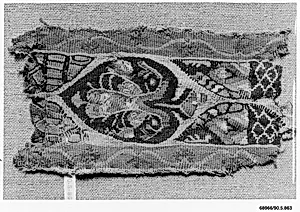
Fragment of a Band
Unknown Artist
6th century
Medium
Linen, wool
Dimensions
Max. H. 6 3/8 in. (16.2 cm) Max. W. 3 1/8 in. (8 cm)
Classification
Textiles
Department
Islamic Art
Museum
Metropolitan Museum of Art, New York, NY
Credit
Gift of George F. Baker, 1890
Accession Number
90.5.863
Rights
Public Domain
Art Historical Context
This delicate *Fragment of a Band*, to the 6th century, offers a glimpse into the sophisticated textile traditions of the Late Antique world, preserved in the Metropolitan Museum of's Department of Islamic Art. Craft from linen and wool, narrow strip—measuring just 6 3/8 inches high 3 1/8 inches wide—was likely part of a larger garment, furnishing, or decorative band. Such fragments, often discovered in archaeological contexts like burials, highlight the perishability of ancient fabrics and the skill required to weave them for everyday or ceremonial use. In the 6th century, textile production flourished across the Near East, Egypt, and Persia, blending influences from Byzantine, Sasanian, and early Coptic cultures—regions that would soon shape Islamic art. Linen provided a fine, lightweight base, while wool added durability and color vibrancy, enabling intricate patterns through techniques like tapestry weaving. Though the artist remains unknown, this piece exemplifies the era's mastery of small-scale designs, possibly featuring geometric motifs or figural elements typical of the time. A generous gift from George F. Baker in 1890, this fragment invites us to appreciate the artistry of anonymous makers whose work adorned lives long ago, bridging the pre-Islamic world to the rich textile heritage of Islamic civilizations.