
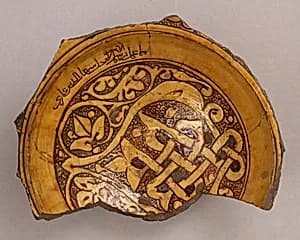
Fragment of a Bowl
Unknown Artist
14th–15th century
Medium
Earthenware; incised decoration through white slip and coloring under transparent glaze
Dimensions
H. 3 5/16 in. (8.4 cm) W. 8 3/4 in. (22.2 cm) D. 6 3/4 in. (17.1 cm) Wt. 21.4 oz. (606.7 g)
Classification
Ceramics
Department
Islamic Art
Museum
Metropolitan Museum of Art, New York, NY
Credit
Rogers Fund, 1907
Accession Number
07.237.27
Rights
Public Domain
Art Historical Context
This delicate fragment of a bowl, dating to the 14th–15th, offers a glimpse into the refined world of Islamic ceramics. Housed in the Museum of Art's Department of Islamic Art and acquired through the Rogers Fund in 1907, it measures just 3 5/16 inches high and 8 3/4 inches wide, hinting at the graceful curve of its original form. Such fragments are treasures, preserving artistry from everyday objects that rarely survive intact. Crafted from earthenware the piece showcases a sophisticated technique: incised decoration through a white slip—a liquid clay coating—revealing the body beneath, with added coloring sealed under a transparent glaze. This method, popular in the Islamic world from Persia to Syria, allowed artisans to create intricate patterns with luminous depth and vibrancy. The glossy finish not only protected the ware but enhanced its visual appeal, making even humble bowls works of beauty. In the bustling trade hubs of the medieval Islamic realm, ceramics like this bridged utility and luxury, influencing global pottery traditions. Though incomplete, this fragment whispers of skilled hands and vibrant markets, inviting us to imagine the feasts and rituals it once graced.