
Fragment of a Bowl
Unknown Artist
14th–15th century
Medium
Stonepaste; white slip; blue underglaze; transparent, colorless glaze
Classification
Ceramics
Department
Islamic Art
Museum
Metropolitan Museum of Art, New York, NY
Credit
Rogers Fund, 1907
Accession Number
07.238.53
Rights
Public Domain
Tags
Art Historical Context
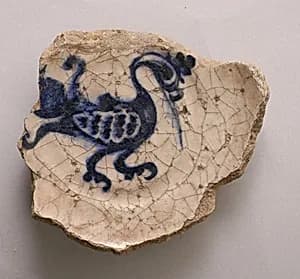
This enchanting fragment of a bowl, dating to the 14th–15th century, hails from the rich tradition of Islamic ceramics, likely produced in Persia (modern-day Iran) during a golden age of artistic innovation under Timurid or late Ilkhanid patronage. Acquired through the Rogers Fund in 190 and now housed in the Metropolitan Museum Art's Islamic Art Department it exemplifies the exquisite craftsmanship of anonymous artisans who elevated everyday objects into vessels of storytelling and beauty. Crafted from stonepaste—a composite of quartz, clay, and frit that mimicked Chinese porcelain's translucency—this shard features a white slip base painted with vibrant blue underglaze motifs, sealed by a transparent, colorless glaze. This technique, perfected in centers like Kashan, allowed for durable, luminous surfaces ideal for intricate designs. The surviving imagery hints at mythical creatures, a favored theme in Islamic art symbolizing cosmic forces, protection, or the fantastical realms of folklore, blending Persian, Chinese, and local influences. Though only a fragment, it whispers of banquet halls where such bowls held fruits or sweets, dazzling guests with their otherworldly allure. A testament to cultural exchange along the Silk Road, it invites us to imagine the hands that shaped it and the eyes that admired its magic.