
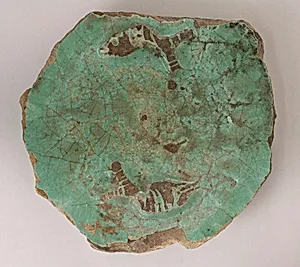
Fragment of a Bowl
Unknown Artist
14th–15th century
Medium
Earthenware; applied molded decoration, glazed
Classification
Ceramics
Department
Islamic Art
Museum
Metropolitan Museum of Art, New York, NY
Credit
Rogers Fund, 1908
Accession Number
08.256.132
Rights
Public Domain
Art Historical Context
### Fragment of a Bowl This delicate fragment from a bowl, dating to the 14th–15th century, offers a glimpse into the vibrant of Islamic ceramics. Crafted from earthenware—a durable, everyday clay favored in the Islamic world—the piece features applied molded decoration and a glossy glaze. These techniques transformed simple vessels into works of art, with raised motifs likely depicting floral patterns, geometric designs, or calligraphy, hallmarks of the period's aesthetic sophistication. In the Islamic artistic tradition, ceramics flourished as a key medium for cultural expression, especially in regions like Persia, Syria, and Egypt during the medieval era. Artisans mastered glazing to create luminous surfaces that mimicked coveted Chinese porcelain, while molded relief added texture and depth. Though only a fragment survives, it speaks to the bowls' role in daily life—from communal meals to elite dining—blending utility with beauty. Acquired through the Rogers Fund in 1908, this piece at the Metropolitan Museum of Art exemplifies the technical innovation of Islamic potters, whose influence rippled across continents via trade routes. A testament to enduring craftsmanship, it invites us to ponder the hands that shaped it centuries ago.