
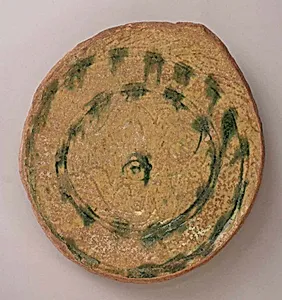
Fragment of a Bowl
Unknown Artist
probably 10th–12th century
Medium
Earthenware; incised decoration through white slip and coloring under transparent glaze
Classification
Ceramics
Department
Islamic Art
Museum
Metropolitan Museum of Art, New York, NY
Credit
Rogers Fund, 1908
Accession Number
08.256.145
Rights
Public Domain
Art Historical Context
This exquisite fragment of a bowl, dating to the 10th–12th century, a glimpse into the vibrant of medieval Islamic ceramics. Produced during a golden age of artistic innovation across the Islamic world—from Persia to Syria and beyond—this earthenware piece exemplifies the technical mastery of potters who transformed everyday vessels into objects of beauty. Acquired through the Rogers Fund in 8, it now resides in the Metropolitan of Art's Department of Islamic Art, preserving a shard of history. The bowl's decoration showcases a sophisticated technique: a white slip was applied over the earthenware body, then incised to reveal the reddish clay beneath in intricate patterns—a method known as sgraffito. Vibrant coloring was added before a transparent glaze sealed the design, creating a luminous, jewel-like effect. This labor-intensive process not only enhanced durability but also allowed for rhythmic motifs like florals or geometrics, reflecting Islamic artistry's emphasis on harmony and abstraction. Though only a fragment survives, it speaks volumes about cultural exchange along trade routes, where pottery techniques evolved through influences from China to the Mediterranean. For visitors, it's a tactile reminder of how Islamic artisans elevated functional ceramics to fine art, blending utility with poetic elegance.