
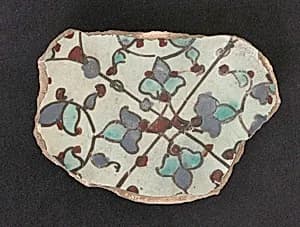
Fragment of a Bowl
Unknown Artist
13th–14th century
Medium
Stonepaste; underglaze painted
Dimensions
Ht. 3 15/16 in. (10 cm) W. 2 15/16 in. (7.5 cm) D. 1 in. (2.5 cm)
Classification
Ceramics
Department
Islamic Art
Museum
Metropolitan Museum of Art, New York, NY
Credit
Rogers Fund, 1908
Accession Number
08.256.233
Rights
Public Domain
Art Historical Context
This delicate fragment of a bowl, hailing from the Islamic world of the 13th–14th century, offers a glimpse into the sophisticated ceramic traditions of the medieval Middle East. Though only a small piece—measuring about 4 inches high and 3 inches wide—it survives as a testament to the artistry of an unknown potter, likely from regions like Iran or Syria where such wares flourished under patronage of courts and mosques. Crafted in stonepaste, a innovative composite material blending quartz, clay, and frit, the bowl mimicked the prized translucency of Chinese porcelain, which was unavailable locally. The underglaze painting technique—where pigments are applied directly to the unfired body before a transparent glaze is added and the whole fired—ensured vibrant, durable colors that withstood daily use. This method marked a pinnacle of Islamic ceramic innovation, blending functionality with aesthetic beauty in everyday vessels. Acquired through the Rogers Fund in 1908 and now in the Metropolitan Museum of Art's Islamic Art Department, this fragment highlights the cultural exchange along Silk Road trade routes. It invites us to imagine the complete bowl gracing a merchant's table or a scholar's shelf, echoing the era's blend of technology, faith, and artistry.