
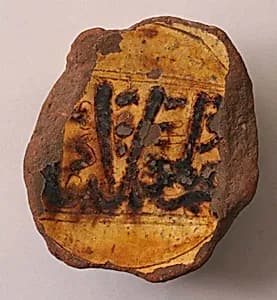
Fragment of a Bowl
Unknown Artist
14th–15th century
Medium
Earthenware; incised decoration through white slip and coloring under transparent glaze
Classification
Ceramics
Department
Islamic Art
Museum
Metropolitan Museum of Art, New York, NY
Credit
Rogers Fund, 1908
Accession Number
08.256.265
Rights
Public Domain
Art Historical Context
This exquisite fragment of a bowl, dating to the 14th–15th century, offers a glimpse into the refined world of Islamic ceramics. Crafted from earthenware, it hails from a period when pottery flourished across the Islamic world, Persia to the Mediterranean, serving both practical daily use and artistic expression. Though only a portion survives, it evokes the elegance of complete vessels once used for serving food or as cherished household items. The bowl's decoration showcases a sophisticated technique: incising through a white slip layer to reveal the reddish body beneath, then applying colored pigments sealed under a transparent glaze. Known as sgraffito or mishna in Islamic traditions, this method created dynamic contrasts and intricate patterns, blending functionality with artistry. The glossy glaze not only protected the surface but also enhanced its luminous quality, a hallmark of the era's technical mastery. As part of the Metropolitan Museum of Art's Islamic Art collection, acquired through the Rogers Fund in 1908, this fragment highlights the cultural exchange and innovation in medieval Islamic ceramics. It reminds us how everyday objects carried profound aesthetic value, bridging art and life in vibrant historical civilizations.