
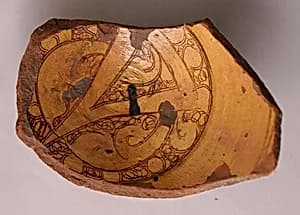
Fragment of a Bowl
Unknown Artist
14th–15th century
Medium
Earthenware; incised decoration through white slip and coloring under transparent glaze.
Dimensions
H. 2 13/16 in. (7.1 cm) L. 7 1/16 in. (18 cm) W. 4 7/8 in. (12.4 cm)
Classification
Ceramics
Department
Islamic Art
Museum
Metropolitan Museum of Art, New York, NY
Credit
Rogers Fund, 1913
Accession Number
13.190.111
Rights
Public Domain
Art Historical Context
This delicate fragment of a bowl, to the 14th–15th, offers a glimpse into the refined world of Islamic ceramics. Crafted from earthenware, it features incised decoration carved through a white slip—a technique known as sgraffito—revealing the underlying clay body. Vibrant coloring was then applied before a transparent glaze sealed the surface, creating a luminous,-like effect that was prized in the Islamic world. Produced during a golden age of pottery production across regions like Persia, Syria, and Egypt, such bowls were everyday objects elevated to art through masterful craftsmanship. The white slip and glaze mimicked costly porcelain from China, showcasing Islamic potters' ingenuity in adapting and innovating techniques. Though only a fragment (measuring 2 13/16 in. high, 7 1/16 in. long, and 4 7/8 in. wide), it hints at intricate motifs—likely floral or geometric—that symbolized paradise gardens and cosmic order in Islamic culture. Acquired through the Rogers Fund in 1913 and housed in the Metropolitan Museum of Art's Islamic Art department, this piece underscores the technical sophistication and aesthetic beauty of medieval Islamic artisans, bridging utility and artistry for both palace and home.