
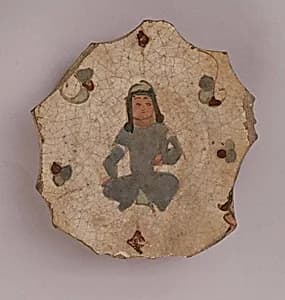
Fragment of a Bowl
Unknown Artist
12th–13th century
Medium
Stonepaste; overglaze painted (mina'i)
Classification
Ceramics
Department
Islamic Art
Museum
Metropolitan Museum of Art, New York, NY
Credit
The Grinnell Collection, Bequest of William Milne Grinnell, 1920
Accession Number
20.120.125
Rights
Public Domain
Tags
Art Historical Context
This exquisite fragment of a bowl hails from the 12th–13th century, a golden of Islamic ceramics during the Seljuk dynasty in Persia (modern-day Iran). Crafted by an unknown artist, it belongs to the prestigious mina'i ware tradition, produced primarily in workshops at Kashan. Displayed in the Metropolitan Museum of Art's Islamic department as part of The Grinnell Collection (bequest of William Milne Grinnell, 1920), this piece invites us to glimpse the opulence of medieval courtly life. The bowl is made of stonepaste—a fine, white frit body that mimics porcelain's translucency—and adorned with overglaze painting (mina'i), a groundbreaking technique. Artists applied colorful enamels over a glazed surface, firing them at low temperatures to achieve vibrant hues like turquoise, gold, and deep blues that wouldn't survive high-heat kilns. This allowed for intricate scenes, likely featuring men in this fragment, perhaps in dynamic compositions of hunters, courtiers, or revelers, reflecting themes of leisure and heroism in Persian culture. Mina'i ware was a luxury good, rivaling metalwork and textiles for elite patrons, symbolizing technical mastery and artistic innovation. Though only a fragment survives, it embodies the ingenuity of Islamic artisans, blending functionality with storytelling artistry for us to admire today.