
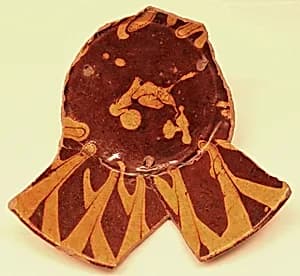
Fragment of a Bowl
Unknown Artist
16th–17th century
Medium
Earthenware; red and yellow slip decoration under transparent glaze
Dimensions
H. 3 5/16 in. (8.4 cm) W. 7 3/8 in. (18.7 cm) D. 7 1/2 in. (19.1 cm) Wt. 12.2 oz. (345.9 g)
Classification
Ceramics
Department
Islamic Art
Museum
Metropolitan Museum of Art, New York, NY
Credit
Rogers Fund, 1938
Accession Number
38.40.282
Rights
Public Domain
Art Historical Context
This delicate fragment of a bowl, hailing from the Islamic world of the 16th–17th century, offers a glimpse into the everyday artistry of a vibrant ceramic tradition. Crafted from earthenware, it features red and yellow slip decorationliquid clay pigments trailed or brushed onto the surface—sealed beneath a transparent glaze that lends a luminous sheen. Measuring just over 3 inches high and7 inches wide, this sturdy yet lightweight piece (12.2 oz.) likely once formed part of a larger serving bowl used in households or for communal meals. The slip technique, a hallmark of Islamic pottery from regions like Anatolia or the Levant, allowed artisans to create vivid, contrasting patterns without the costly blue-and-white porcelain of Chinese influence. Red and yellow slips, derived from local clays and metal oxides, evoked warmth and earthiness, often adorning geometric motifs, florals, or calligraphy that symbolized prosperity and faith. Though incomplete, the fragment preserves the tactile joy of these wares, which bridged utility and beauty in Ottoman or Safavid courts and homes. Acquired through the Rogers Fund in 1938 and now in the Metropolitan Museum of Art's Islamic Art Department, this survivor underscores the fragility of history—reminding us how such humble objects illuminate the ingenuity of unnamed makers across centuries.