
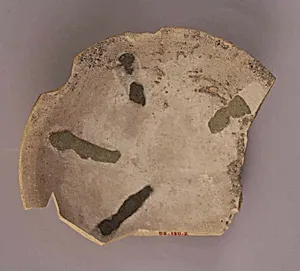
Fragment of a Bowl
Unknown Artist
9th century
Medium
Earthenware; white slip with glazed decoration
Dimensions
H. 1 15/16 in. (5 cm) W. 5 3/16 in. (13.1 cm) D. 4 3/16 in. (10.7 cm) Th. 3/16 in. (0.4 cm)
Classification
Ceramics
Department
Islamic Art
Museum
Metropolitan Museum of Art, New York, NY
Credit
Gift of Noel E. Baker, 1952
Accession Number
52.130.2
Rights
Public Domain
Art Historical Context
This delicate fragment of a bowl, dating to the 9th century, offers a glimpse into the vibrant world of early Islamic ceramics. Crafted during the Abbasid Caliphate—a golden age of Islamic culture centered in Baghdad—this earthenware piece exemplifies the period's innovative pottery traditions. Produced likely in regions like Iraq or Mesopotamia, such bowls were everyday vessels that blended utility with artistry, reflecting the era's advancements in trade, technology, and aesthetic refinement. The medium is earthenware coated with white slip—a fine clay layer applied to create a smooth, pale canvas—then adorned with glazed decoration. This technique, fired at low temperatures, allowed artisans to paint intricate designs that vitrified into a glossy, durable finish under transparent glaze. Though only a fragment survives (measuring about 2 inches high and 5 inches wide), it hints at the sophisticated color palettes and motifs—perhaps geometric patterns or florals—typical of Islamic ceramics, which avoided human figures in favor of abstract beauty. Housed in the Metropolitan Museum of Art's Islamic Art department (gift of Noel E. Baker, 1952), this shard underscores the cultural exchange along Silk Road routes, where Islamic potters drew from Persian, Byzantine, and Chinese influences. It reminds us how fragile artifacts preserve stories of skilled hands and bustling markets from over a millennium ago.