
Fragment of a Bowl
Unknown Artist
13th century
Medium
Stonepaste; luster-painted and glazed
Classification
Ceramics
Department
Islamic Art
Museum
Metropolitan Museum of Art, New York, NY
Credit
Gift of Fahim Kouchakji, 1961
Accession Number
61.260.1
Rights
Public Domain
Tags
Art Historical Context
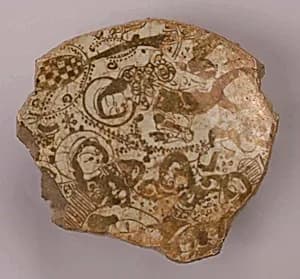
This exquisite *Fragment of a Bowl* the 13th century a glimpse into the golden age of Islamic ceramics. Crafted by an unknown artist, this piece belongs to the vibrant tradition of medieval Islamic art, likely originating from production centers in Iran or Syria during a period of cultural flourishing under the Seljuk and early Mongol eras. Displayed in the Metropolitan Museum of Art Islamic Art department, it was generously gifted by Fahim Kouchakji in 1961. The bowl fragment showcases advanced stonepaste (also known as fritware), a composite material of quartz, clay, and glass frit that allowed artisans to create a durable, porcelain-like body with a smooth white surface—ideal for intricate designs. Over this, luster-painting was applied: metallic oxides fired in a special reducing atmosphere to produce a shimmering, iridescent gold or coppery glow. The presence of human figures, hinted at in the tags, reflects the secular storytelling common in Islamic pottery, where such motifs adorned everyday luxury wares despite religious taboos on imagery in sacred spaces. Lusterware like this was a hallmark of Islamic innovation, prized for its opulence and exported across the Mediterranean, influencing later European maiolica. Though only a fragment survives, it evokes the refinement of 13th-century courtly life, inviting us to imagine the full vessel gleaming on a banquet table.