
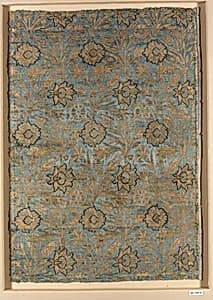
Fragment of a Brocaded Silk
Unknown Artist
17th century
Medium
Silk, metal wrapped thread; brocaded
Dimensions
L.18.5 in. (47 cm) W. 13.25 (33.7 cm)
Classification
Textiles-Woven
Department
Islamic Art
Museum
Metropolitan Museum of Art, New York, NY
Credit
Rogers Fund, 1908
Accession Number
08.109.9
Rights
Public Domain
Tags
Art Historical Context
This exquisite *Fragment of a Broc Silk* from the 17th century a glimpse into the opulent world of Islamic textile artistry. Woven from luxurious silk with metal-wrapped threads, the brocading technique creates raised, shimmering patterns through supplementary wefts floated across the ground fabric. Measuring 18.5 by 13.25 inches, this surviving piece likely once adorned garments, furnishings, or ceremonial objects, showcasing the era's mastery of loom-based decoration. In the Islamic world of the 17th century—spanning regions like the Ottoman Empire, Safavid Persia, and Mughal India—textiles were prized symbols of wealth and refinement. Floral motifs, hinted at here, evoked gardens of paradise, a recurring theme in Islamic art that blended aesthetic beauty with spiritual resonance. The use of metal threads, often gold or silver, added a jewel-like luster, making such fabrics ideal for elite patrons and courtly splendor. Acquired through the Rogers Fund in 1908 and now housed in the Metropolitan Museum of Art's Islamic Art Department, this fragment preserves a delicate craft tradition. Though its exact origin remains unknown, it highlights how woven textiles rivaled painting and architecture in cultural prestige, inviting us to appreciate the weavers' anonymous genius.