
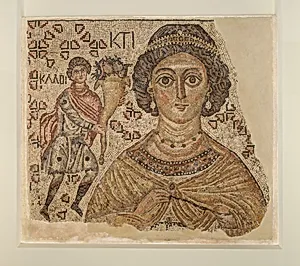
Fragment of a Floor Mosaic with a Personification of Ktisis
Unknown Artist
500–550, with modern restoration
Medium
Marble and glass
Dimensions
59 1/2 x 78 5/8 x 1 in. (151.1 x 199.7 x 2.5 cm)
Classification
Mosaics
Culture
Byzantine
Department
Medieval Art
Museum
Metropolitan Museum of Art, New York, NY
Credit
Harris Brisbane Dick Fund and Fletcher Fund, 1998; Purchase, Lila Acheson Wallace Gift, Dodge Fund, and Rogers Fund, 1999
Accession Number
1998.69; 1999.99
Rights
Public Domain
Tags
Art Historical Context
This stunning fragment of a Byzantine floor mosaic, dating to around 500–550 CE with modern restoration, captures the Personification of Ktisis—a classical figure symbolizing the foundation or building of structures. Crafted from vibrant marble and glass tessera, the 59½ × 78⅝-inch panel likely adorned a wealthy villa or church floor in the Eastern Mediterranean, where such mosaics celebrated patrons and divine abundance. Ktisis, often depicted as a graceful woman holding a cornucopia (a horn of plenty), embodies prosperity and architectural patronage, flanked here by male figures that may represent donors or builders. In the transition from Late Antiquity to early Byzantium, floor mosaics like this one were a pinnacle of artistic technique, using tiny, durable tesserae to create intricate patterns that withstood heavy foot traffic while dazzling viewers from above. The interplay of glass for luminous highlights and marble for texture highlights Byzantine mastery of light and opulence, drawing on Roman traditions while infusing Christian symbolism. Today, housed in The Metropolitan Museum of Art's Medieval Art department, this fragment offers a glimpse into a world of imperial splendor and spiritual devotion. Its survival speaks to the enduring legacy of Byzantine art, blending mythology, daily life, and eternal themes of creation and plenty.