
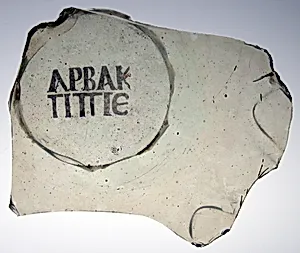
Fragment of a Glass Bowl
Unknown Artist
3rd century
Medium
Glass, gold leaf
Dimensions
Overall: 2 3/4 x 4 in. (7 x 10.2 cm)
Classification
Glass-Gold glass
Culture
Roman
Department
Medieval Art
Museum
Metropolitan Museum of Art, New York, NY
Credit
Rogers Fund, 1916
Accession Number
16.174.1
Rights
Public Domain
Art Historical Context
This delicate fragment from a 3rd-century Roman bowl showcases the exquisite artistry of gold glass, a luxurious technique where thin sheets of gold leaf were engraved with designs and sealed between two layers of glass. Measuring just 2¾ x 4 inches, small shard—likely part of a larger vessel—highlights the Romans' mastery of combining transparency and opulence, creating vessels that shimmered like jewels under candlelight. Gold glass emerged in the late Roman Empire, particularly in Rome and its environs, during a time of cultural transition from pagan traditions to early Christianity. These objects were prized for banquets and memorials, with the gold providing enduring brilliance protected from wear. Though the full design is lost, the fragment's survival speaks to the fragility and rarity of such wares, many discovered in catacombs or shipwrecks. Now housed in the Metropolitan Museum of Art's Medieval Art Department (acquired via the Rogers Fund in 1916), this piece offers a glimpse into everyday luxury of the ancient world, bridging classical antiquity and the medieval era. Visitors, imagine sipping wine from a bowl that caught the light like buried treasure!